1. I. Introduction and Background Study
ace recognition research started in the late 1970s and has become one of the most active and exciting research areas in computer vision and pattern recognition since 1990s. Many algorithms have been developed for face recognition in the last years. Among the crucial issues of face recognition technology, the low-dimensional feature represent action with enhanced discriminatory power is of paramount importance in face recognition systems [1].
Many dimension reduction methods are proposed in the past research, such as linear discriminant analysis (LDA) [2], principal component analysis (PCA) [3], and independent component analysis [4], and so on. But for face recognition problem, owing to the nonlinear and complex distribution of face images under a perceivable variation in viewpoint, illumination or facial expression, the linear techniques, such as PCA or LDA, cannot provide reliable and robust solutions to those face recognition problems with complex face variations [1]. In this paper, we have applied a method to propose morphological analysis for face recognition.
2. II. PROPOSED METHODOLOGY
The main objective of our work is to develop a technique that recognizes face using morphological analysis. The step by step procedure has been discussed below:
? Step 1: Choose a set of training image from any directory under various situations to get required image whose information is required for training purposes.
? Step 2: Find the binary images from the original images.
?
Step 3: Morphological operations on the training set of images are done to calculate the average intensity value. We also calculate the minimum and maximum value from the set values of the training images.
The information is stored for further processing of the face recognition.
? Step 4: Select an input image which completely or slightly differs from the training images.
? Step 5: Face recognition of the input image is done. Newly calculated average intensity value is compared with database images. The mostly matched image is used to identify the name of the person.
The overall procedure of proposed image recognition technique is illustrated in Fig. 1. The component of the algorithms like binary image processing, erosion and dilation are described in the sub section A. 1
3. i. Binary Image Processing
A binary image is a digital image that has only two possible values for each pixel. Typically the two colors used for a binary image are black and white though any two colors can be used. The color used for the object(s) in the image is the foreground color while the rest of the image is the background color. In case of binary operation we approach by this procedure:
? Step 1: Take an input as a binary image and convert it into two dimensional images such as 640*480, 480 *320 and so on. Then intensity value like 0 and 1 will be found. ? Step 2: Add all these pixels value by this way 0+1+1+1+1+0+1+1+?????.and finally found the total pixel value for the face region.
? Step 3: Since we get all input from database thus the size of the all pixel are comparatively same. Now we divide the binary image pixel value with the total pixel value to get a value which ranged from 0 to 1.
4. b) Structuring Element
The basic idea in binary morphology is to probe an image with a simple, pre-defined shape, drawing conclusions on how this shape fits or misses the shapes in the image. This simple "probe" is called structuring element, and is itself a binary image (i.e., a subset of the space or grid).
Dilation is an operation that "grows" or "thickens" objects in a binary image. The specific manner and extent if this thickening is controlled by a shape referred to as structuring element. This image was produced by two dilation passes using a disk shaped structuring element. Dilation is one of the two basic operators in the area of mathematical morphology, the other being erosion. It is typically applied to binary images, but there are versions that work on grayscale images. The basic effect of the operator on a binary image is to gradually enlarge the boundaries of regions of foreground pixels (i.e. white pixels, typically). Thus areas of foreground pixels grow in size while holes within those regions become smaller.
5. III. EXPERIMENTAL ANALYSIS
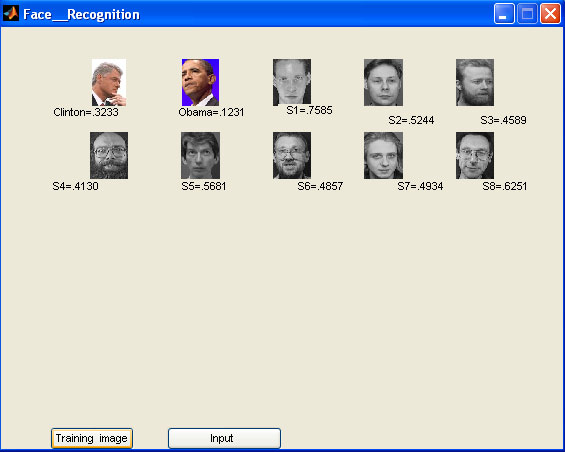
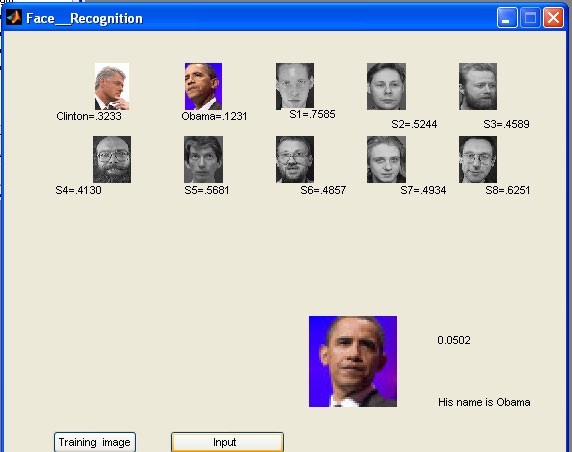
The experiment has been done on 400 images for training purposes. For the clarity of the algorithm, we included 20 images of US Ex-president Obama and Clinton. The algorithm is tested with 40 images and performed significantly well than the existing state of the art. The detection procedure of an image is shown in Figure 4. It has been shown the image of Barak Obama. The average intensity value which is obtained here found very close to the training images intensity value. This makes the assumption that the image is the Ex-president Obama. The comparative analysis of our new improved face recognition method with other face recognition method is given in Table 1.
6. IV. EXPERIMENTAL ANALYSIS
In this paper, For our experiment we built the model by using approximately 400 training images which reflected on the accuracy of the algorithms. It should be tested for various methods and then can be select the best one. Here all sets of pictures contains in one database. For further improvement we can experiment with multiple databases. Kernel Optimization criteria can be used for future improvement.
| Start | ||
| Trained Image | ||
| Input Image | ||
| Calculate Intensity | Measure Intensity | |
| Value | value | |
| Calculate | Calculate | |
| Max,Min,Avg | Max,Min,Avg | |
| No | Is | Yes |
| Similar? | ||
| The Face Is Not Recognized | Face is Recognized | |
| Difference From All | Exit | |
| Images Based on | ||
| Intensity Value | ||
| Take the Minimum | ||
| Recognize the Image | ||
| Exit |
| Characteristics | Existing models | New Improved model |
| Required space for | ||
| processing the | More | Comparatively less |
| trained image | ||
| Time Required for | ||
| processing the | More | Comparatively less |
| trained image | ||
| Accuracy | Low | High |