1. Introduction
emote cell frameworks have been being used since 1980s.we have seen their developments to in the first place, second and third era's remote frameworks. These frameworks work with the backing of a brought together supporting structure, for example, an entrance point. The remote clients can be associated with the remote frame work by the assistance of these entrance focuses, when they meander from one spot to the next.
The versatility of frameworks is constrained by the vicinity of an altered supporting direction. It implies that the innovation can't work effectively in that places where there is no perpetual framework. Simple and quick organization of remote systems will be normal by the future era remote frameworks. This quick system organization is impractical with the current structure of present remote frameworks.
Late head ways, for example, Bluetooth presented a crisp kind of remote frame works which is every now and again known as versatile specially appointed systems. Versatile impromptu systems or "short live" systems control in the nonexistence of perpetual framework. Portable specially appointed system offers speedy and level system arrangement in conditions where it is impractical something else.
Impromptu is a Latin word, which signifies "for this or for this just". Mobile specially appointed system is a self-ruling arrangement of versatile hubs joined by remote connections; every hub works as an. as a system shaped of heterogeneous hubs and a portion of the hubs may have more than one remote interfaced and the remote interfaces can be of diverse remote advances along these lines, the course are heterogeneous courses.
2. II.
3. Related Work
The Table-driven DSDV convention is a adjusted variant of the Distributed Bellman-Ford (DBF) Algorithm that was utilized effectively as a part of numerous element bundle exchanged systems. The bellman-ford strategy gave a method for ascertaining the most limited ways from source to destination hubs, if the measurements to every connection are known. DSDV utilizes this thought, yet defeats DBF's propensity to make directing circles by including a parameter called destination-grouping number. In DSDV, every hub is obliged to transmit a grouping number, which is intermittently expanded by two and transmitted alongside whatever other steering redesign messages to every single neighbouring hub. On gathering of these redesign messages, the neighbouring hubs utilize the accompanying calculation to choose whether to The ad hoc on demand distance vector routing (AODV) convention is a responsive unicast steering convention for versatile impromptu systems. As a receptive steering convention, AODV just needs to keep up the directing data about the dynamic ways. In AODV, the steering data is kept up in the directing tables at all the hubs. Each portable hub keeps a next bounce steering table, which contains the destinations to which it as of now has a course. A directing table passage terminates in the event that it has not been utilized or reactivated for a pre specified close time.
On demand tree based routing protocol used to combining the levels of node by node by using the algorithm is Tree based optimized flooding. Which can be used to increase the connectivity and extending the network lifetime.
In OTRP (on demand tree based routing protocol) will process the work based on the intermediate nodes from source node to the destination node. Here the route request send to every node based on transfer the information is same as AODV protocol.
In light of system size and unidirectional connection to be discovering the heterogeneous courses from source to destination by utilizing the force mindful heterogeneous steering convention. These attributes make MANET conventional directing conventions awkward in a heterogeneous situation III.
4. Motivation
In mobile ad hoc network the energy consumption problems occurred like battery status of mobile nodes. Mainly in mobile nodes the Bluetooth and Wi-Fi connection formed on wireless technology and Bluetooth node consumes how much energy consumption compare to Wi-Fi connection. It overcome those problems by using to know their energy status of neighbouring nodes to transfer the data IV.
5. Statement of a Problem
Multi-interfaced node with low energy could continue to fall on optimal routes and such a node could offer a link between heterogeneous nodes where no other link is possible. Thus, such a node could suffer energy shortage and fade out from the network.
V.
6. Proposed System
To integrate updated message to the proposed messages which allows a node to signal to neighboring nodes its residual energy status and enforce the modification of power cost.
7. VI.
8. Problem Domain
Basically network is collection of nodes. In mobile ad hoc network is a wireless network that is 1. Infrastructure network 2. Infrastructure less network Coming to our problem is infrastructure less network i.e Bluetooth, Wi-Fi connection are like here data traffic, power consumption problems are occur so here how much energy consumed by those are formed in infrastructure less network. ESB= SBE/PBE where SBE is Starting battery power of the node in joules, maintain at starting level. and PBE -present battery power at node . The battery cost of a node increases when it consumes more of its energy. The present battery power PBE changes according to the mobility of the node. In the event that the hub is unmoving, it utilizes a steady division of its vitality consistently and its PBE is redesigned whenever a point happens from unmoving to send accepting utilize clock to record the quantity of seconds the hub spent in an unmoving state. PBE=PBE-CJ × r CJ is the power used per second by an idle node r is the idle duration of a hub in seconds when a hub moves from forwarding or receiving state to another state Results IX.
9. Analysis Results
In experimental design,let us taking 20 nodes of their residual enery status based on finding the best path from source to destination as follows. Here we are taking the available routes between source to destination of their energy based to transmit the data.
10. a) Input
Suppose Select the source node is:25 Suppose select the destination node is:34
11. Conclusion
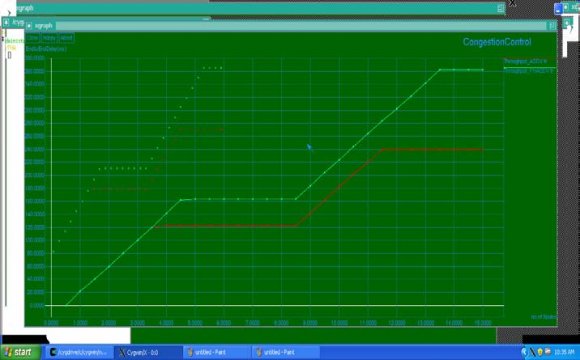
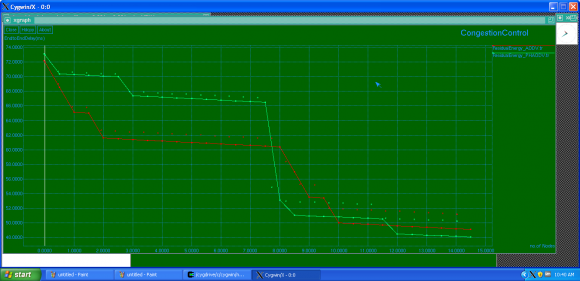
In these paper, the proposed approach was implemented in network simulator and its performance was compared to that of AODV, PHAODV. The performance metrics was taken into the through put, and residual energy status. By using those metrics to signal the residual energy status of neighbouring nodes based on easily transferring the messages from source to destination. The Future work resides the modification of energy cost and threshold levels depend on the node residual energy, which may decreasing error messages across the network.
networking and application (ANIA-2013);Barcelona Spain; Marh 2013. 5. Safa H, Artail H, Shibli R." an interoperability model for supporting reliability and power-efficient routing in MANETs" Ad Hoc Ubiquitous computing 2009.

| Step 1.Source sends the request message to all neighbours | Step 9. otherwise ignore the request and update route parameters | |||
| Step 2. Request message from same node then | Step 10. DD_Route+DD_Dest,PC_Route+PC_Dest | |||
| Step 3. Ignore the request | Step 11. Generate route reply message.. | |||
| Step 4. Else update the route table | VII. | Simulation Model | ||
| Step 5. If node is a destination Step 6. Produce route reply message | yes to analyze the performance of the system. Here we In this experiment we are setting different nodes | |||
| Same Step 7. Node >threshold level and Integrate message start RREQ Step 8. DD_Route,PC_Route, and Conv_Route and flood request | routing consider 50 nodes, we configure the nodes with wireless No table based on SRC network properties. Here we are implementing in the Network Simulator 2 | |||
| Channel type | Wireless channel | |||
| Radio propagation model | Two ray ground | |||
| Network interface | Wireless/phy | |||
| MAC type | MAC/802_11 | |||
| Interface queue type | Queue/Drop tail | |||
| Link layer type | LL | |||
| Antenna model | Omni Antenna | |||
| Number of nodes | 50 | |||
| VIII. | Msg parameters based on update | |||
| routing table | ||||
| If node | ||||
| is | ||||
| destinatio | ||||
| Yes | Residual energy | |||
| >threshold | ||||
| and signal | ||||
| energy status | ||||
| No | Valid | |||
| route to destinat | yes | |||
| Update route parameters | Update route parameters is | |||
| Conv Route,PC Route | DD_Route,ML_Route | |||
| Flood route request | Generate route reply message | |||
| End | ||||
| Figure : RREQ processing flow chart | ||||